 Sunplug
Sign in
Sunplug
Sign in
Features → Export limits
Export limits and curtailed solar
Many inverters are set to hold what they send to the grid at or below a fixed figure — nothing at all, or a kilowatt, or five. Whenever the sun offers more than the house, the cars and that ceiling can take, the inverter throttles its own production to fit. The meter only ever sees what crosses it, so a reading of no surplus does not mean the sun went anywhere.
This is for a standing limit: one figure, set once, that does not move through the day. Zero export in France is the strictest case of it, and a partial cap — Germany's 70% feed-in limit, an installer's 5 kW ceiling — is the same arrangement with a different number. Dynamic export limits, like Australia's, are not yet supported: the detector would behave correctly during any one window, but the setting and the history behind it both assume the limit is standing rather than something that moves.
What you see
The dashboard reads no surplus under a clear sky, and a car plugged in all afternoon never charges on solar. At a zero limit, with a battery, this starts the moment it hits 100% — production suddenly tracks house load to the watt, having shown several kilowatts spare an hour before. Without a battery it is not a moment but the standing state of any sunny day.
At a positive limit the same thing happens a little higher up. Production climbs until the export reaches the ceiling and then stops climbing, and whatever is left over the house and the ceiling together is simply never made. The surplus figure sits at the ceiling all afternoon and looks, from the meter, exactly like a roof that had no more to give.
Why it happens
An export limit is a rule the inverter enforces on itself. With the battery full, or with no battery to begin with, there is nowhere to put what would cross the ceiling — so the inverter curtails its own production to exactly what the house is drawing plus whatever it is still allowed to send. The sun has not gone anywhere; it has just been told to stop.
Sunplug's surplus figure is production minus consumption, and under curtailment the inverter holds those two numbers a fixed distance apart on purpose. So the surplus never grows past the ceiling and nothing beyond it ever triggers. Absence of surplus is not absence of sun — the same mistake that trips up a stale sensor reading, here applied to production itself rather than to a reading of it.
What Sunplug does about it
Below the ceiling, nothing changes. A roof exporting 0.5 kW under a 1 kW limit still has room to give, so the surplus on the meter is real surplus and the cars charge on it exactly as they do anywhere else. Sunplug only has something to find when the export is sitting at the limit, which is the one reading that means production is being held back.
When it is, Sunplug asks for slightly more than the meter shows. Faced with demand it is not meeting, the inverter has no reason left to hold back: it makes what it can. What covers the difference depends on your setup — a home battery supplies it without buying anything, or, on a site with no battery, it comes from a small grid import instead. Either way it is brief and it is deliberate: the point is to find out whether the sun is there, and the answer arrives within minutes.
Sunplug does not guess blind. It waits for the right signature — export pinned to the ceiling, no material import or discharge for a while — then stakes a car's starting current on that hypothesis for a few minutes. If the sun really was there, production climbs and the car charges on it. If it wasn't, the attempt ends on its own — a small, deliberate cost set against a whole afternoon of curtailed sun if nothing is tried at all. Attempts are spaced well apart — and after one that finds nothing, Sunplug waits considerably longer before trying again: a failed attempt is itself a reading of today's sky.
Evenings are left alone: whether the shortfall shows up as the battery covering the house or the grid quietly doing the same job, either one means the sun is gone for the day rather than being curtailed.
The number you set
There are two limits in this story and they are not the same thing. One is the figure your inverter is actually set to, which lives in the inverter and which Sunplug can neither read nor change. The other is the figure you set in Settings, which is Sunplug's belief about the first one. Everything above works only while the two agree.
So move the slider to the limit your installer set, exactly. It runs from 0 to 20 kW in tenths. If your limit is zero, leave it at zero. If the inverter is capped at 1 kW, put it on 1 — and Sunplug will then treat an export sitting at 1 kW as the signature of curtailment, and an export of 0.5 kW as an ordinary afternoon with room to spare.
If the value you set is too high, Sunplug may not detect curtailment. Tell it 1 kW when the inverter is really at zero and the export will never reach the figure Sunplug is watching for, so nothing ever triggers and the feature quietly does nothing. That failure is safe — it spends nothing and charges exactly as it did before — but it is silent, so the number is worth checking against your installer's paperwork rather than guessed at.
Too low is the noisier mistake: Sunplug sees an export above the ceiling it was told about, says so, and treats those readings as unusable rather than pretending to understand them. Moving the slider to the right figure puts it right from that moment on.
One thing to know if you use Sunplug on an older phone or an older installed app: a version that predates export limits only knows the original yes-or-no switch. Turning the feature off and on again from one of those sets the limit back to zero, because zero is the only ceiling that switch can express. Set your figure again from an up-to-date app afterwards.
Where the expectation comes from
Knowing whether an attempt is worth making needs some idea of what the roof normally manages at this point in the day — and while production is being curtailed the meter is precisely the thing that cannot say. So Sunplug asks the household's own record instead: what did this array actually produce at this time of day, at this point in the year, in the moments it was demonstrably free to produce?
That last clause carries the weight. The stored history is curtailed too, so an average of "production at two o'clock" would learn the curtailment rather than the sun. Only the moments where the energy provably had somewhere to go get a vote — the house was importing, or the battery was moving, or the export was clearly below the ceiling with room to spare. A moment sitting exactly at the ceiling might have been curtailed, so it stays silent. What comes back is the median of the rest, not the best day ever recorded: the question is whether there is normally sun now, not whether there was once.
The window is narrow on both axes — within about three-quarters of an hour of the current time, and within a fortnight of today's place in the year. Nine in the morning is not solar noon, and December is not July.
This is the part that improves on its own. The record reaches back well over a year, so once a household has been running that long, this fortnight last year answers alongside this fortnight now — a site with a season behind it asks a better question than one in its first week. And a household with no record yet gets no answer at all rather than an answer of zero: too few usable moments and Sunplug declines to say, falling back to probing blind exactly as it did before any of this existed. An empty record is never read as an empty sky.
This is a record, not a forecast. No weather service is involved and no outside data of any kind — it is your own array's measured history and nothing else. It decides only whether an attempt is worth making; what the car actually gets is still found by making it. And it runs only where an export limit is declared: everywhere else the meter shows live production all day long, and a guess would be a worse input than the measurement.
What it costs
A battery helps: the extra demand draws from it rather than from the grid, and the sun repays it once production climbs back — minus 10–15% lost to the round trip of charging and discharging. Without a battery there is nothing to draw from instead, so the same energy is bought from the grid. It is a real cost and a small one, spent in short tests rather than continuously, and set against an afternoon of sunshine that would otherwise never have been made at all.
Turning it on
Settings → Advanced → Solar tracking, at the bottom of the section: My inverter has an export limit, marked Experimental. Switch it on and put the slider on the figure your inverter is set to. Leave it off if your inverter exports freely: on an unlimited connection, a full battery and no surplus simply mean the sun is gone, and forcing the demand would import from the grid for nothing.
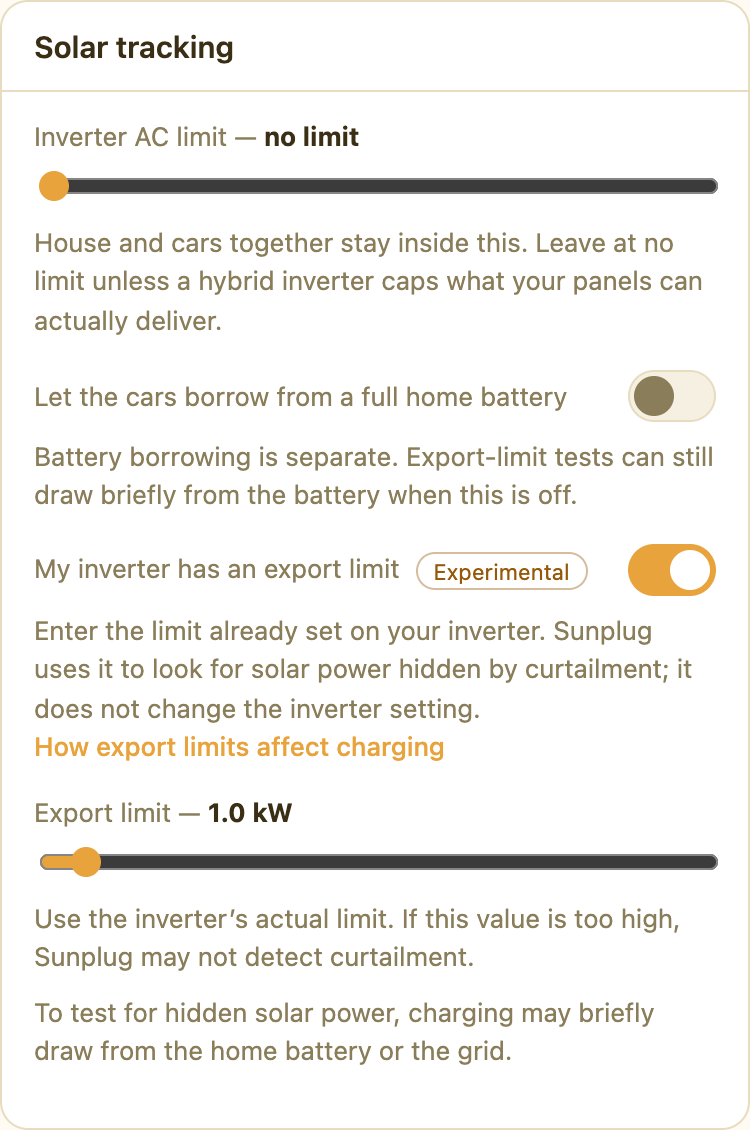
Setting the limit here does not change your inverter. Sunplug never writes to it; the figure is only how Sunplug reads what the meter is telling it.
Questions? Email me — I'll tell you where the setting stands on your account.